BBC World News recently shared a powerful story about the plight of Samoa's national bird with its global audience of 99 million viewers.
 The Manumea, a unique tooth-billed pigeon, is only found in Samoa, but there are now estimated to be less than a few hundred left. The Manumea is classified as “Critically Endangered” by the International Union for Conservation of Nature (IUCN), the global body that assesses the risk of extinction of species. A Critically Endangered species is one facing a very high risk of extinction in the wild and it is the highest risk category assigned by the IUCN Red List for wild species.
The Samoa Conservation Society (SCS) has recently teamed up with Auckland Zoo, Samoa's Ministry of Natural Resources and Environment (MNRE) and PelGar International Limited to try and save the Manumea before it is too late.
The Manumea is also known as the "Little Dodo" because it is the closest known relative to the Dodo which famously became extinct almost 400 years ago.
Every day Samoan’s see the Manumea on 20 tala notes and 50 sene coins but soon this could be the only record left of Samoa's beloved national symbol.
The “Little Dodo” is threatened by habitat loss, invasive species, especially cats and rats, as well as hunting. Manumea is often accidentally shot as a “by-catch” by hunters targeting Lupe (Pacific pigeon) even though all forms of hunting of native birds and bats is illegal in Samoa.
 Conservation of the Manumea is complicated by its secretive nature and the fact that its call seems to be mimicked by the Pacific pigeon making positive identification of the bird very tricky.
To help conserve the remaining population of Manumea, SCS and MNRE are working together with the Auckland Zoo and local communities where Manumea is found. Other partners including the Flinch Marketing company from New Zealand are developing a National Manumea Protection Campaign to reduce the impact of hunting on native birds and to protect their forest habitat.
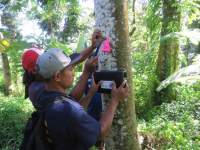
Work is being done to establish rainforest conservation areas on both Upolu and Savaii as well as the management of rats at the Malololelei forest reserve on Upolu. PelGar International Limited is supplying the rodent stations and ROBAN.

Gerwyn Jones (Asia Pacific Manager for PelGar International) said he was delighted that ROBAN was chosen for such an important conservation project, and this is the first time this rodent bait has ever been used in Samoa.
The reason why ROBAN (difenacoum) was used is due to the lower risk of secondary poisoning compared to other baits containing brodifacoum and flocoumafen.
The conservation activities are supported by grants from the UK Darwin Initiative through the Australian National University and from the NZ Government’s Pacific Development and Conservation Trust.
Back to Newsletter